
The Complete Strategy for Local SEO
Most businesses that have a Google Business Profile do not post on it. Of the businesses that do post, most post inconsistently — a burst of activity followed by weeks of silence.
Both of these are mistakes, and both cost ranking positions that consistent posting would have protected.
GBP posts are one of the most underused Prominence signals in local SEO. They cost nothing, take minutes to publish, and every post is a direct signal to Google that your profile is actively managed by a business that is open and engaging with its customers.
This guide covers exactly how posts affect your ranking, which post types to use and when, what the actual expiry rules are, and how to build a posting strategy that compounds over time.
GBP posts do not directly increase your ranking in the way that category selection or review velocity do.
Their effect on ranking is indirect, operating through the Prominence signal.
Google evaluates Prominence as an aggregate of how well-known, active, and trusted a business appears to be.
A profile that is posting consistently is a profile that is signalling active management, and active management is a component of Prominence.
The specific mechanism: Google’s systems treat consistent GBP posting as evidence that a business is currently operating and engaged with its customers.
A profile with a post from last week reads as active. A profile whose last post was seven months ago reads as potentially inactive or less engaged, even if the business is operating normally.
This active management signal contributes to the Prominence score alongside reviews, photo activity, and engagement metrics.
What posts do for conversion, not just ranking
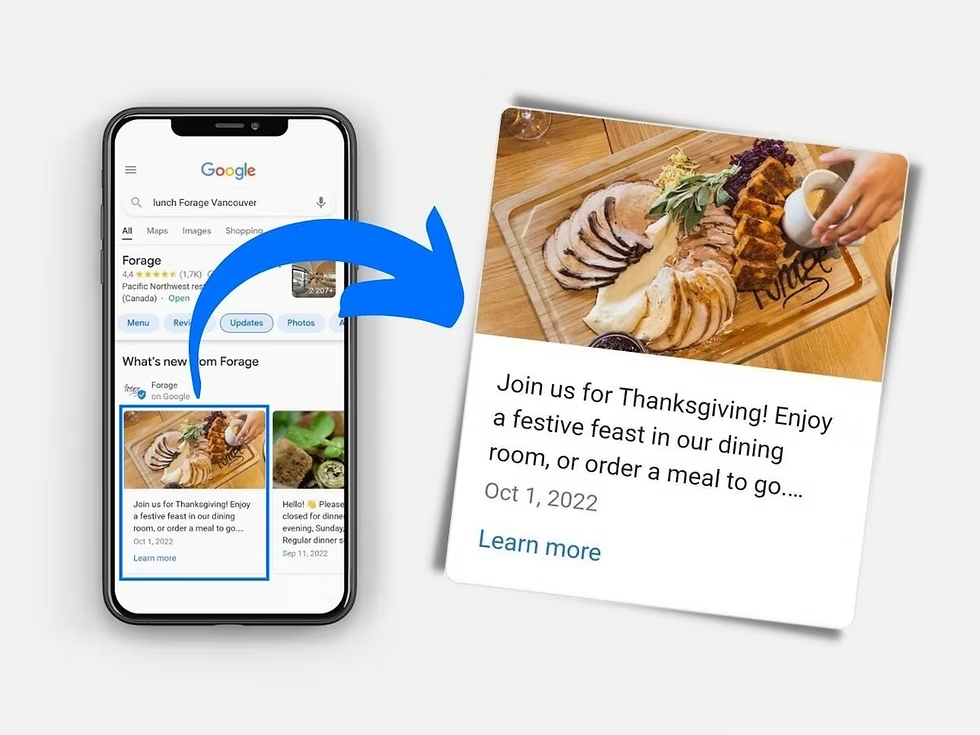
Beyond the Prominence signal, posts serve a direct conversion function. They appear on your Google Business Profile in Maps and search results, and customers who are evaluating your profile after finding it in the Map Pack can see your recent posts.
A post announcing a current promotion, a recent project completion, a new service addition, or a forthcoming event gives prospective customers a reason to engage beyond the basic profile information.
Posts with clear calls to action and links to relevant pages on your website also drive traffic from your GBP profile to the specific content most likely to convert that visitor.
From real optimisation work on GBP profiles: businesses that post consistently receive more clicks from their profile to their website than identical profiles that do not post.
The posts create additional touchpoints on the profile that engaged customers explore before making contact.
Each click from a post to a website page is also a behavioral engagement signal that contributes to Prominence.
See How Your Post Activity Compares to Competitors
GMB Crush’s competitor audit shows you the post count and frequency of every business outranking you — so you know exactly how active your competition is and what posting cadence you need to match.
Google provides four distinct post types for Google Business Profile, each designed for a different purpose and each appearing slightly differently on the profile.
Understanding what each type is for and when to use it is what separates a deliberate posting strategy from random posting activity.
What’s New posts
What’s New posts are the general-purpose update format for anything happening in your business that does not fit a specific promotion or event format.
New services added, new team members joining, new equipment installed, operational updates, recent projects completed, industry news relevant to your customers — all of these work as What’s New posts.
They are the format to default to for weekly posting activity when there is no specific offer or event to promote.
What’s New posts support a photo, a description of up to 1,500 characters, and a call to action button linking to any URL. The call to action options include ‘Learn More,’ ‘Book,’ ‘Order Online,’ ‘Buy,’ ‘Get Offer,’ and ‘Call Now.’ For most businesses, ‘Learn More’ linking to a relevant service or blog page is the most natural call to action for What’s New posts.
Offer posts
Offer posts are specifically designed for promotions — discounts, special pricing, limited-time deals, or any other incentive you want to make visible to prospective customers.
They display a promotional badge on your Map Pack listing when active, which distinguishes them visually from the standard listing and increases click-through rate for searches that display your profile.
Offer posts require a title, a start and end date, and optionally a coupon code, link, or terms and conditions. They remain visible until their specified end date rather than expiring after seven days like standard posts.
For businesses that run ongoing promotions, an Offer post with a specified end date several weeks or months in the future maintains prominent promotional visibility on the profile for the full duration.
Event posts
Event posts are for business-hosted activities with a specific date and time: open days, workshops, webinars, seasonal events, community involvement activities, or anything else that has a defined start and end.
They require a title, start date and time, and end date and time. An event description and a link to a ticketing page, registration form, or dedicated landing page can also be included.
Event posts remain active for the duration of the event plus a short period after it ends. For businesses that run regular events, maintaining a current Event post on the profile is a consistent way to signal active engagement without the seven-day expiry limitation of standard posts.
Product posts
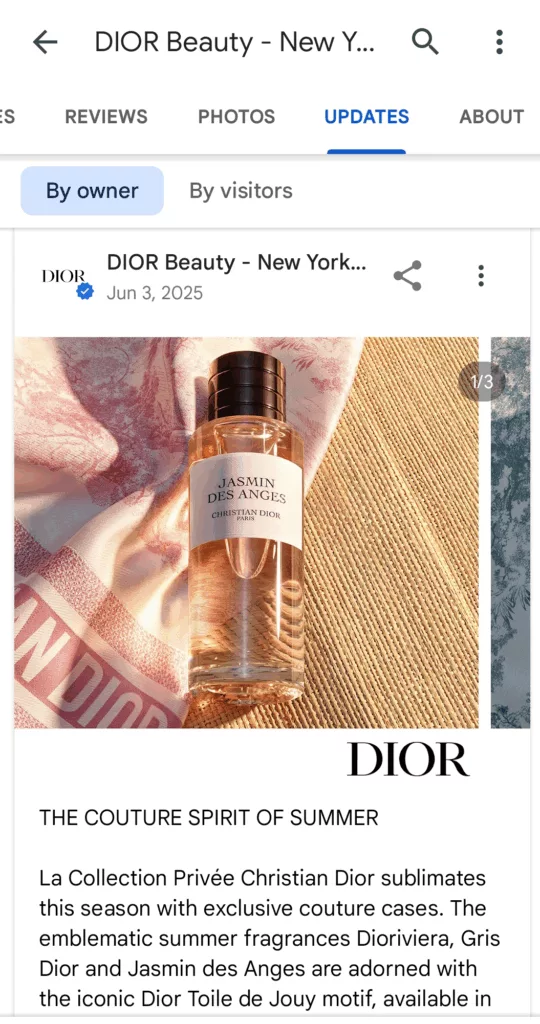
Product posts are available for certain business categories and allow you to feature specific products with photos, descriptions, and pricing directly on your profile.
They appear in a product carousel on your listing and allow customers to browse what you offer without leaving Google.
For retail businesses, cafes, and other product-focused categories, maintaining a current product catalogue through product posts adds a browsable layer to your profile that drives engagement and signals relevance for product-specific searches.
- Post Expiry: What Actually Happens
Post expiry is one of the most frequently misunderstood aspects of GBP posting, and getting it wrong has operational consequences.
Here is what actually happens to each post type.
What’s New posts: 7-day expiry
Standard What’s New posts expire and are removed from the visible section of your profile after seven days.
They do not disappear from Google’s index immediately — expired posts remain visible in the ‘Posts’ section of your Google Business dashboard and may remain indexed for longer — but they no longer appear prominently on your live profile for prospective customers.
This is the reason that consistent weekly posting is necessary to maintain active post visibility on your profile at all times.
A business that posts once per month has their profile displaying no visible posts for roughly three weeks out of every four.
A business that posts weekly always has a current, active post visible. From the prospective customer’s perspective — and from Google’s activity assessment — these are completely different profiles.
Offer posts: expire on the specified end date
Offer posts remain active and visible on your profile until the end date you specified when creating them.
If you create an Offer post with an end date three months from now, it will remain visible on your profile for three months.
This makes Offer posts the most efficient format for maintaining continuous promotional visibility on your profile without the weekly posting commitment that What’s New posts require.
Event posts: expire after the event ends
Event posts remain active on your profile until the event end date passes, plus a short grace period afterward.
For ongoing businesses that run regular events, maintaining a current Event post provides continuous activity visibility without the seven-day limitation.
The most common posting mistake is creating one post per month and assuming it is still visible to prospective customers three weeks later. It is not. Standard What’s New posts expire after seven days. If you are not posting at least weekly, your profile is displaying no active posts for most of the month.
Your Competitors Are Already Using GMB Crush
GBP audits, geo-grid ranking maps, competitor analysis, review monitoring, and AI Overview insights. All in one platform. Start your 14-day free trial today.
How often you should post on your GBP profile is one of the most frequently asked questions about the platform.
The honest answer is that frequency matters more than content quality for the Prominence signal, and the minimum effective frequency is once per week.
Why frequency outweighs content quality for ranking purposes
A business that posts once per week with a simple, straightforward update about something happening at the business consistently outranks, on the posting signal alone, a business that posts once per month with a beautifully designed promotional graphic.
The ranking contribution of posting comes from the activity signal — the consistent evidence that the profile is live and managed — not from the sophistication of the content.
This does not mean content quality is irrelevant. For conversion — the customer who sees your post and decides whether to engage — content quality absolutely matters.
But for the Prominence component of ranking, a steady posting cadence of any quality outperforms infrequent posting of high quality.
The competitive posting benchmark
The right posting frequency for your market is determined by what your competitors are doing, not by an arbitrary general recommendation.
GMB Crush’s competitor audit shows you the post count and posting frequency of every business outranking you in your Map Pack. If the top-ranking practice in your market posts three times per week, posting once per week may not be enough to match their activity signal. If they post once per month, weekly posting immediately puts you ahead on this signal.
Use the competitor posting data to set your frequency target against the actual competition in your market, not against a general best practice that may be irrelevant to your specific competitive environment.
- Writing Posts That Work for SEO and Conversion
A GBP post that maximises both its ranking signal and its conversion potential has four elements: relevant content, a location mention, a clear call to action, and a link to a specific page. Here is what each element does and how to implement it.
Content: keep it specific and current
The most effective post content is specific to something currently happening in your business.
A post about a specific service you completed this week, a specific product that just arrived, a specific promotion running this month, or a specific event coming up gives customers real, current information rather than generic messaging.
Specific content is also more engaging and more likely to be read completely, which contributes to the engagement signal the post generates.
Keep post descriptions between 150 and 300 words for most post types. Long enough to provide substantive information, short enough to be read on mobile without scrolling.
The first two sentences are the most important — they are visible without expanding the post. Write your most compelling information first.
Location mentions: geographic relevance reinforcement
Including your location in GBP posts reinforces the geographic relevance of your profile for local searches.
A plumber who posts ‘We completed an emergency drain clearance in Didsbury this week’ is adding a natural location mention that strengthens the geographic entity signal for their business in that area.
A restaurant that posts ‘Join us in our Soho location this Saturday for our wine tasting event’ is reinforcing their specific location signal with every post.
Location mentions do not need to be forced or repetitive. A natural reference to the area where you operate, the neighborhood you serve, or the specific location where something happened is sufficient.
One natural location mention per post is the right target — more begins to feel formulaic.
Call to action: every post needs one
A GBP post without a call to action is a missed conversion opportunity. Every post should tell the reader what to do next.
The most effective CTAs for GBP posts connect the post content to a specific action:
- ‘Book a consultation’ linking to your booking page
- ‘View the full menu’ linking to your restaurant menu page
- ‘Read the full case study’ linking to your website blog or portfolio
- ‘Claim this offer’ linking to a landing page for the promotion
- ‘Register for our event’ linking to your event registration page
Use the built-in CTA button options in Google’s post interface — ‘Book,’ ‘Order Online,’ ‘Learn More,’ ‘Get Offer,’ ‘Call Now’ — and always link to the most specific relevant page rather than your homepage.
Images: use original photos from your business
Every post should include an image. Posts with images receive significantly more engagement than text-only posts.
The most effective images are original photos from your actual business — your work, your team, your premises, your products. Stock images and generic graphics produce lower engagement than authentic business photography and do not contribute to the geographic or entity signals that original photos add.
For the best display, use landscape images at a minimum of 1200 x 900 pixels.
Google crops and resizes post images for different display contexts, and a high-resolution original ensures your image looks sharp in all contexts.
Map Your Ranking Across Your Full Service Area
GMB Crush’s geo-grid shows your Map Pack position at every point in your area. See exactly where your profile is strong and where competitors are taking the customers you should be winning.
The optimal post mix varies by business category because the types of content that are most relevant to customers differ significantly across business types.
Here is a practical posting framework for the most common local business categories.
Trade and home service businesses (plumbers, electricians, HVAC, cleaners)
The most effective post types for service businesses are What’s New posts showing completed work and Offer posts for seasonal promotions. Post about a recently completed job type once or twice per week — blocked drain cleared, boiler serviced, electrical rewire completed — with a natural location mention.
These posts demonstrate current activity, reinforce service keyword relevance, and provide social proof that the business is actively taking jobs.
Seasonal Offer posts (summer air conditioning service, pre-winter boiler check) drive direct enquiries for the services with the most seasonal demand.
Restaurants and food businesses
Restaurants have the richest content opportunities of any local business category. Weekly specials, new menu additions, seasonal menus, events, and chef features all provide consistent post material.
The most conversion-effective posts for restaurants are Offer posts for time-sensitive deals and Event posts for regular events like quiz nights or tasting menus.
Photo quality matters more for restaurant posts than most other categories — food photography that makes the dish look appetising directly drives reservation and order decisions.
Professional services (lawyers, accountants, consultants)
Professional service businesses should focus on What’s New posts that demonstrate expertise and current activity.
Recent case outcomes (without identifying client information), regulatory updates relevant to clients, new services or team additions, and award or accreditation announcements all make natural post content.
The tone should reflect the professional standard of the practice — authoritative, specific, and client-focused rather than promotional.
Retail businesses
Retail businesses benefit most from Product posts for featured stock and Offer posts for promotions. What’s New posts announcing new arrivals, seasonal stock changes, and special ordering availability drive both online and foot traffic.
Event posts for in-store events, launch days, and seasonal promotions maintain consistent visibility for time-bound customer activity.
- Posts and AI Search Visibility
GBP posting activity has taken on additional significance as AI-driven local search formats become more prominent.
The active management signal that consistent posting provides contributes to the profile characteristics that make a business more likely to appear in AI Pack results and AI Overview recommendations.
How AI systems use post activity data
Google’s AI systems evaluate the recency and frequency of profile activity as one of the inputs to their local business recommendation logic.
A profile with consistent recent posting activity signals an active, currently operating business. An AI system generating a recommendation for a local service provider is more likely to confidently recommend a business with a current, active profile than one whose most recent post is from six months ago, all other factors being equal.
Post content also contributes to the AI’s understanding of your business’s current services and offers. A recent post announcing a new service or a current promotion may be incorporated into an AI-generated business summary in a way that a six-month-old post would not. Keeping your post content current and specific is the most direct way to ensure your AI-visible profile accurately represents what your business is offering right now.
The compound effect of consistent posting over time
A business that has posted consistently for twelve months has built an activity signal history that a business that started posting last month cannot replicate.
The compound effect of consistent GBP posting is one of the few local SEO advantages that is genuinely difficult for competitors to close quickly — it requires sustained effort over time, not a one-time investment.
Starting now and posting consistently is the only way to build it.
Recommended Reading
GBP Optimization: the complete 14-step guide including the full profile activity strategy
- GMB Crush Takeaways
GBP posts are free, take minutes to publish, and contribute to the Prominence signal that determines your Map Pack position.
The businesses that post consistently are building an activity advantage over competitors who do not.
Here is what to implement:
- Post at minimum once per week using What’s New posts: a business posting weekly always has an active, current post visible on its profile. A business posting monthly has no active post visible for three weeks out of every four. Frequency is more important than sophistication.
- Use Offer posts for any active promotion and set an end date weeks or months away: Offer posts display a promotional badge on your Map Pack listing and remain visible until their specified end date, providing continuous promotional visibility without the weekly posting requirement.
- Include one natural location mention per post: a reference to your area, your neighbourhood, or the specific location where a service was delivered reinforces your geographic relevance signal with every post.
- Add a call to action to every post linking to a specific page: each CTA converts a post reader into a website visitor, adds a behavioral engagement signal, and gives the customer a clear next step. Link to your booking page, a relevant service page, or a specific offer landing page — not your homepage.
- Run a GMB Crush competitor audit to benchmark your post frequency: check how many posts the businesses outranking you have published in the last 90 days and set your frequency target against their actual activity, not a generic recommendation.
Consistent posting does not replace the higher-leverage optimisations — category precision and review velocity will move your ranking faster.
But posts are the easiest, cheapest, and most accessible Prominence signal available, and the businesses that ignore them are leaving a compounding activity advantage on the table.
Start posting weekly, apply the strategy above, and the activity signal builds itself.
One Platform. Every Local Ranking Signal.
Audit, optimise, track, and outrank. GMB Crush gives local businesses and agencies the data to build and maintain the GBP activity signals that drive consistent Map Pack rankings. 14-day free trial, no credit card required.
