
How Review Text Shapes Your Local SEO Signals
Most businesses think about Google reviews in terms of star ratings and count. Google thinks about them as a structured dataset.
Every review your business receives is processed by Google’s systems for signals that go beyond the star rating: which specific qualities customers mentioned, what aspects of the experience they highlighted, and which themes appear consistently across your review corpus.
This analysis produces the Review Attributes and Place Topics that appear on your profile — and contributes to how confidently Google can match your business to specific local searches.
Understanding how this system works tells you something important: the text content of your reviews is not just a trust signal for prospective customers.
It is indexed keyword evidence that influences your relevance for the specific queries your best customers are using to find you.
This guide covers how review attributes are generated, what they mean for your local SEO, and how to build a review acquisition strategy that produces the right attribute signals over time.
Table of Contents
Google Review Attributes are the descriptive quality tags that appear on a business’s GBP profile, drawn from the content of customer reviews.
On mobile devices in particular, these attributes appear as clickable labels on a profile — terms like ‘professional,’ ‘responsive,’ ‘good value,’ ‘on time,’ ‘clean,’ or more specific service-related terms depending on the business category.
Customers can tap these labels to filter reviews by that attribute and see the specific feedback that led Google to surface it.
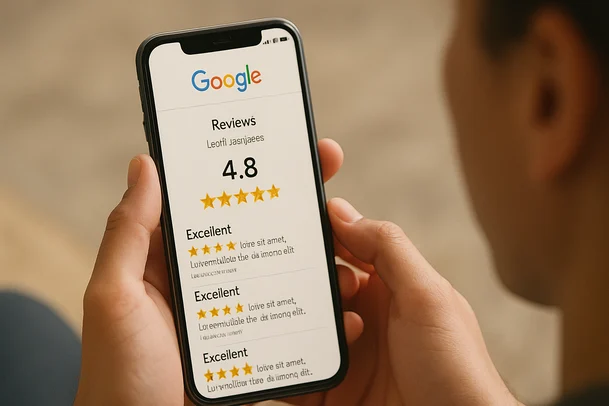
Attributes are not manually entered by the business owner. They are generated automatically by Google’s natural language processing systems analysing the text content of customer reviews.
A business that consistently receives reviews mentioning ‘fast response’ will accumulate a ‘responsive’ attribute. A business whose reviews frequently mention ‘fair pricing’ will accumulate a ‘good value’ attribute.
The attribute profile that appears on your listing is a reflection of what your reviewers have actually said about you, processed and categorised by Google.
Which businesses have review attributes
Review attributes are not available for every business category. They appear most prominently for service-based categories: plumbers, electricians, HVAC contractors, auto repair shops, lawyers, accountants, cleaners, and similar trades and professional services.
They also appear for hospitality and food businesses, healthcare providers, and fitness businesses, though the specific attribute categories available vary by primary GBP category.
The availability of specific attributes for your business is determined by your primary GBP category.
The attributes that appear as options for a plumber are different from those that appear for a dentist or a restaurant. Some categories have a rich set of available attributes; others have fewer.
Checking what attributes your category supports — by looking at the review interfaces of top-ranked competitors in your category — tells you which attribute signals are available for you to build.
See How Your Review Profile Compares to Competitors
GMB Crush’s competitor audit shows your review count, velocity, and profile configuration against the businesses outranking you — so you can see exactly where your review signals are falling short.
Alongside the structured review attributes, Google uses AI to generate Place Topics — a different but related feature that surfaces the most frequently discussed themes across all reviews for a business.
Place Topics appear as clickable tags at the top of a business’s reviews section, allowing prospective customers to filter reviews by topic without reading every individual review.

How Place Topics differ from review attributes
Review attributes are structured, predefined quality dimensions that Google maps specific review text to: ‘professional,’ ‘responsive,’ ‘clean.’
Place Topics are more organic — they emerge from whatever themes are most prevalent across a business’s review corpus, regardless of whether those themes map to a predefined attribute category.
A restaurant’s Place Topics might include ‘pasta,’ ‘outdoor seating,’ and ‘weekend brunch.’ A dental practice’s might include ‘Invisalign,’ ‘gentle hygienist,’ and ‘parking.’ A plumber’s might include ‘boiler repair,’ ‘same day,’ and ‘explained the work.’
Place Topics are generated when a business has a sufficient volume of reviews for Google’s systems to identify recurring themes.
The specific volume threshold varies, but most businesses begin to see Place Topics appearing once they have accumulated several dozen reviews with substantive text content. Profiles with many short or text-free reviews may have fewer or no Place Topics even at higher review counts.
Why Place Topics matter for local SEO
Place Topics are indexed content that Google uses to understand what a business actually specialises in, beyond its formal category and services menu.
A plumber whose Place Topics include ‘boiler installation’ and ’emergency callout’ has demonstrable evidence from customer feedback that these are genuine, frequently delivered service types.
This evidence contributes to the confidence with which Google can rank that profile for boiler installation and emergency plumber searches — reinforcing the relevance signals from the category configuration and services menu with real customer-generated confirmation.
- How Attributes Are Generated from Review Text
Understanding how Google generates review attributes from review text is the practical foundation of any strategy to improve your attribute profile.
The process is not random and it is not purely sentiment-based — it is keyword and theme extraction applied at scale across your review corpus.
Natural language processing of review content
Google’s systems process every text review your business receives, identifying the specific words, phrases, and themes present.
When the same term, concept, or quality dimension appears across multiple reviews above a certain frequency threshold, Google maps it to a corresponding attribute category and surfaces it on your profile.
A business where fifteen reviews mention words related to punctuality — ‘on time,’ ‘arrived when they said,’ ‘no waiting around,’ ‘punctual’ — will develop a strong ‘on time’ attribute signal. A business where only two reviews mention punctuality will not.
The threshold for attribute visibility is not a fixed number but a relative measure influenced by the total volume of reviews and the frequency of the relevant terms within them.
A business with 30 reviews where 20 mention professionalism has a stronger ‘professional’ attribute signal than one with 100 reviews where 10 mention professionalism, despite the lower total volume.
The keyword signal layer
The specific words in your reviews are indexed by Google as keyword signals, separate from their attribute classification function. A review that says ‘they unblocked our drain in under an hour, professional and fairly priced’ adds ‘drain unblocking,’ ‘professional,’ and ‘fair price’ as indexed terms to your profile’s keyword evidence.
These terms contribute to your relevance signal for the corresponding search queries — not just to your attribute profile, but to the underlying keyword matching that determines whether your profile surfaces for specific searches.
This is the mechanism that makes review text content genuinely significant for local SEO, beyond its obvious function as social proof for prospective customers.
A business whose reviews naturally contain the service terms that its customers search for is building keyword relevance evidence that the services menu and business description cannot fully replicate, because review content is seen by Google as third-party confirmation rather than self-reported claims.
The key factor is this: your review text is not just customer feedback — it is third-party keyword evidence that Google indexes and uses to evaluate your relevance for specific local searches. A services menu says you offer emergency plumbing. Reviews that mention emergency callouts confirm that you actually deliver it. Google weights confirmed evidence more heavily than claimed evidence.
Review attributes affect local ranking through two mechanisms: directly, as a component of the review signal layer within Prominence, and indirectly, through the keyword relevance they contribute to Relevance scoring.
The Prominence dimension
Within Google’s Prominence signal, the richness of a profile’s review data contributes to how well-established and trustworthy the business appears.
A profile with a large review corpus containing substantive text, producing multiple positive attribute tags, reads as more established and more comprehensively proven than a profile with the same number of reviews but predominantly text-free ratings.
Two businesses with identical star ratings and similar review counts can have meaningfully different Prominence scores if one has rich textual review content generating multiple attribute signals and the other has mostly one-word or emoji-only reviews.
The Relevance dimension
Review text contributes to Relevance scoring when it contains terms that match specific search queries.
A business whose reviews frequently mention a specific service type — dental implants, emergency drain clearance, commercial electrical work — is building keyword evidence that strengthens its relevance for those specific queries.
This reinforcement is additive to the relevance signals from its category configuration and services menu.
The business that has configured the correct categories, built out a complete services menu, and accumulated reviews that confirm those services in customer language has the strongest combined Relevance signal in its local market.
The AI retrieval dimension
As AI-driven local search formats become more prevalent, the structured content available in your review corpus is increasingly being used to generate AI Pack business summaries and AI Overview recommendations.
Google’s AI systems retrieve attribute data and Place Topic data when constructing these summaries.
A business with strong, specific attribute signals and well-developed Place Topics gives the AI more structured information to synthesise into an accurate, compelling business description. A business with thin review content — mostly ratings without text — gives the AI very little to work with and is more likely to be excluded from AI-generated recommendations.
Your Competitors Are Already Using GMB Crush
GBP audits, geo-grid ranking maps, competitor analysis, review monitoring, and AI Overview insights. All in one platform. Start your 14-day trial today.
- How to Influence Your Attribute Profile
You cannot directly edit or add review attributes to your profile — they are generated by Google from customer review content and cannot be manually modified. What you can influence is the review content that Google has to work with.
The strategy for building a strong attribute profile is a review acquisition strategy that produces specific, keyword-rich review text rather than generic ratings.
Prompt specific reviews, not just any reviews
The most effective change you can make to your review acquisition process is to ask customers to mention what they specifically valued about the service, rather than just asking for a review.
Framing matters significantly here. Compare these two review requests:
- Generic: ‘We would really appreciate a Google review if you have a moment.’
- Specific: ‘If you found our service helpful today, we would love it if you could mention what the work involved in your Google review — it really helps others know what to expect.’
The second prompt produces reviews that mention service types, qualities, and experiences.
Over dozens of reviews, the cumulative keyword evidence from specific review text builds a much richer attribute and Place Topic profile than a collection of generic five-star ratings with no text or brief ‘great service’ comments.

Connecting the ask to the specific service delivered
A review request made immediately after a positive service interaction, when the experience is fresh, that references the specific service delivered, produces the richest content.
‘We really appreciate you leaving a review — if you could mention the boiler installation we completed today, that would be incredibly helpful for future customers.’ Customers given a specific anchor — the boiler installation, the Invisalign consultation, the blocked drain clearance — are much more likely to include that term in their review than those given a generic request.
Over time, this approach produces a review corpus that reads like an evidence portfolio for your most important service types. Each review mentioning a specific service adds another data point to Google’s confidence that your business genuinely delivers it.
Monitoring the attributes that are appearing
Check your Google Business Profile on a mobile device regularly to see which review attributes and Place Topics are currently appearing on your profile.
The attributes currently visible represent the review content themes that have reached Google’s threshold for surfacing.
The attributes you would like to have but do not yet see tell you which service qualities and terms need more review representation. Build your review request prompts around the gaps.
The review attributes appearing on your competitors’ profiles tell you two things: which service qualities their customers most consistently value, and which keyword themes their review corpus has built up enough evidence for Google to surface.
Both pieces of information are useful for your own strategy.
What competitor attribute profiles reveal
A competitor whose profile shows strong attributes for ‘responsive,’ ‘on time,’ and ‘professional’ has accumulated enough customer feedback confirming these qualities to trigger attribute display.
If your profile does not show these same attributes, one of two things is true: either your customers do not value these qualities highly enough to mention them (a service quality issue), or your customers value them but are not mentioning them in reviews because your acquisition prompts are too generic (a review strategy issue).
The attribute comparison helps identify which problem you are solving.
Competitor Place Topics are equally revealing. A competitor whose Place Topics include a specific high-value service type that you also offer — and that does not appear in your own Place Topics — has built review evidence for that service that your profile lacks.
Closing that gap requires review acquisition that specifically references the underrepresented service.
Checking competitor attributes directly
View any competitor’s GBP profile on a mobile device and navigate to their reviews section.
The attributes and Place Topics visible there represent the review content themes Google has surfaced for that profile.
On desktop, the attributes appear in the reviews panel of the business profile page.
For a systematic competitor attribute audit across multiple businesses in your market, GMB Crush’s competitor audit pulls the full profile data of businesses ranking above you, allowing you to identify which attribute and review signals are most consistently present across the top performers in your category and area.
Recommended Reading
GBP Ranking Factors: how review signals contribute to your Prominence score within Google’s local ranking system
Track Your Map Pack Position Across Your Full Area
GMB Crush’s geo-grid shows where you rank across your service area — not just at your address. See where competitors are capturing customers that should be contacting you.
The growing prominence of AI-driven local search formats makes review attribute signals more significant, not less.
As Google’s AI systems take on a larger role in determining which businesses appear in AI Pack results and AI Overview recommendations, the structured evidence available in review content becomes a primary retrieval signal.
How AI systems use attribute and Place Topic data
When Google’s AI constructs a business summary for an AI Pack result, it draws from structured profile data — categories, services menu, attributes — and from review content.
Place Topics and review attributes provide structured signals that the AI can retrieve efficiently and incorporate into a summary.
A business whose Place Topics include ‘dental implants,’ ‘Invisalign,’ and ‘gentle with anxious patients’ gives the AI specific, accurate service and quality descriptors to work with. A business with no Place Topics and mostly text-free reviews gives the AI almost nothing structured to retrieve.
The AI Pack is already appearing for an increasing range of local searches, and the businesses that appear in it most consistently are those whose profiles give the AI enough specific, structured, customer-confirmed information to generate a confident, accurate description.
Review attribute depth is one of the clearest signals available that a business’s profile can offer.
The compound effect of rich review content over time
Review attribute signals compound in a way that most other profile signals do not. Each additional review that confirms a service quality or service type adds to the weight of evidence Google has for that attribute.
A business that has accumulated fifty reviews mentioning professionalism has a stronger ‘professional’ attribute signal than one with five — not just proportionally stronger, but qualitatively more robust, because the pattern is more reliable at larger sample sizes and the AI systems can retrieve it with higher confidence.
Building a rich review attribute profile is therefore a long-term asset that becomes more valuable over time.
The businesses that have been prompting specific, keyword-rich reviews consistently for two or three years have built an attribute and Place Topic profile that a new competitor cannot replicate in months regardless of how many reviews they acquire. Starting the strategy now is the only way to build that advantage.
- GMB Crush Takeaways
Your review text is keyword evidence.
Every review that mentions a specific service, quality, or experience is adding to the attribute signal that Google indexes, displays on your profile, and uses to evaluate your relevance for the corresponding searches.
Here is the practical strategy:
- Shift from generic to specific review requests: instead of asking for ‘a Google review,’ ask customers to mention the specific service or quality they valued. ‘Could you mention the boiler service we completed today in your review?’ produces review content that builds attribute signals. ‘Please leave us a Google review’ produces ratings without text.
- Connect the review request to the specific interaction immediately: a personal ask from the team member who delivered the service, made at the point of a positive experience, followed by a text with your review link within two hours, produces higher response rates and more specific content than any delayed or automated approach.
- Monitor your own attribute and Place Topic profile on mobile regularly: the attributes currently visible are your profile’s current evidence state. The ones missing are the gaps your next round of targeted review prompts should address.
- Audit competitor attribute profiles to benchmark your gaps: the attributes and Place Topics appearing on the profiles outranking you show which customer-confirmed quality signals you need more review evidence for. Build your prompts toward those specific terms.
- Prioritise review text depth for AI Pack readiness: businesses appearing in AI Pack results consistently have review corpora with rich, specific content that gives Google’s AI systems enough structured evidence to generate accurate, confident business summaries. Generic ratings-only review profiles do not provide that evidence and are progressively excluded as AI Pack formats become dominant.
The difference between a review profile that actively builds your local SEO and one that merely accumulates star ratings is the specificity of the text your customers write.
That specificity is within your influence.
Ask better, more specific questions, make the request personal and timely, and the review text that results becomes a compounding keyword evidence asset that strengthens your ranking, your AI Pack visibility, and your conversion rate simultaneously.
One Platform. Every Local Ranking Signal.
Audit, optimise, track, and outrank. GMB Crush gives businesses and agencies the data to build the review profile depth that drives Map Pack rankings and AI Pack visibility. 14-day trial, no credit card required.