
Local Listing Score
Your Google Business Profile does not operate in isolation. Google evaluates your business as an entity, and the confidence it has in that entity is built from the consistency and completeness of your business information across every place on the web where it appears.
What It Is, Why It Matters, and How to Improve Yours
Your Google Business Profile does not operate in isolation. Google evaluates your business as an entity, and the confidence it has in that entity is built from the consistency and completeness of your business information across every place on the web where it appears.
Your local listing score is a measure of how well-represented your business is across that citation ecosystem: how many of the relevant directories have your correct information, how consistently that information matches across sources, and how complete each listing is.
A strong local listing score does not directly rank your business above competitors. What it does is strengthen the entity confidence that underpins your GBP profile’s signals and entity confidence is a foundational component of the Prominence signal that determines Map Pack positions.
This guide covers what a local listing score actually measures, which citations are worth building, and how to build and maintain a citation ecosystem that supports your GBP ranking.
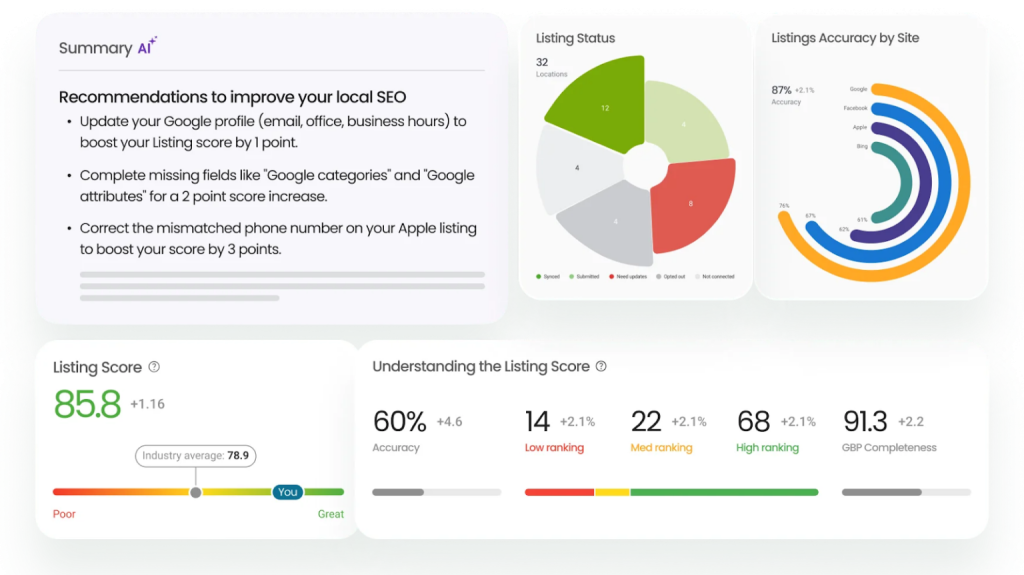
A local listing score is a composite measure of three dimensions of your citation presence: coverage (how many of the relevant citation sources have your business listed), accuracy (whether the name, address, and phone number on each listing match your canonical information exactly), and completeness (how much of each listing’s available fields have been filled in).
All three dimensions contribute to the overall score.

Coverage: are you where you should be?
Citation coverage measures how many of the directories, platforms, and data sources relevant to your business category and geographic market have your listing.
Not every directory matters equally, and having a listing on every available platform is not the goal. The goal is having accurate listings on the sources that Google and its data partners actively pull from when building their understanding of local business entities.
A business that appears on Google Business Profile, Apple Maps, Bing Places, Facebook, Yelp, and the major industry-specific directories relevant to its category has strong citation coverage for the sources that matter most.
A business that also appears on several hundred minor directories but has inconsistent NAP across them may have worse effective coverage than the business with fewer but more accurate listings.
Accuracy: does the information match everywhere?
Citation accuracy measures whether your business name, address, and phone number appear identically across all sources. Even small variations count as inconsistencies: ‘Smith Plumbing Ltd’ vs ‘Smith Plumbing Limited,’ ’42 High Street’ vs ’42 High St,’ a geographic area code vs a local number any of these create a fragmented entity signal that reduces Google’s confidence in your business information.
NAP accuracy is the most widely understood component of a listing score. It is also the component most businesses have not audited since they first set up their listings, which means older listings often have outdated or inconsistent information that has never been corrected.
Completeness: how much have you filled in?
Completeness measures how thoroughly each individual listing has been populated beyond the NAP basics. A Google Business Profile is incomplete if the services menu is empty, the description is missing, there are no photos, and the business hours are absent.
A Yelp listing is incomplete if it has no photos, no business description, and no category-specific attributes filled in.
Completeness matters for both ranking and conversion. A complete listing on any platform is more likely to appear in that platform’s search results and more likely to convert a visitor to a customer than a skeleton listing with only a name and address.
Audit Your Full GBP Profile Against Local Competitors
GMB Crush’s competitor audit shows the complete profile configuration of the businesses outranking you categories, reviews, completeness, and entity signals so your optimisation is based on evidence.
The mechanism through which citations support GBP ranking is entity coherence. Google builds its understanding of any business entity by aggregating information about it from multiple sources.
When your business name, address, and phone number appear consistently across your GBP profile, your website, and a range of external citation sources, Google’s confidence in the entity’s identity and location increases.
That confidence reinforces the Distance and Prominence signals that contribute to your Map Pack position.
The inverse is also true. Inconsistent citations particularly conflicting address information from different sources create entity ambiguity.
Google cannot be fully confident about which address is correct, which reduces the precision of the Distance signal it uses to evaluate your listing for proximity-based searches.
A listing with citation inconsistencies is competing with a weaker geographic signal than a listing with clean, consistent citation data.
Citations as a third-party entity confirmation
Your GBP profile and your website are self-reported sources of information about your business.
Citation listings on directories, review platforms, industry associations, and local data aggregators are third-party sources.
Google weights third-party confirmation of your business information differently from self-reported information specifically, consistent third-party confirmation builds entity trust in a way that self-reported data alone cannot fully replicate.
This is why citation building produces Map Pack ranking improvement even when the GBP profile itself is fully optimised.
The citation ecosystem is building the external confirmation layer that completes the entity picture Google needs to rank your business confidently for location-based searches.
- Which Citations Actually Matter
The citation ecosystem has a clear hierarchy of importance. Focusing effort on the high-tier sources produces most of the entity signal benefit, and diminishing returns set in quickly below the first two tiers.
Understanding the hierarchy allows you to prioritise citation building effort rather than attempting to list your business on every available platform.
Tier 1: Core data sources
These are the foundational citation sources whose data feeds directly into Google’s local business database and into the data aggregators that supply information to multiple downstream platforms simultaneously.
A listing on a Tier 1 source can improve your citation presence across dozens of platforms it feeds, which is why these are the highest-priority sources for any business.
- Google Business Profile: your primary citation and the one that feeds directly into the Map Pack ranking system
- Apple Maps: the second most important location data source globally, feeding iOS Maps, Siri, and Apple services
- Bing Places: feeds Microsoft Bing, Cortana, and LinkedIn business data
- Facebook Business: a major data source that Google cross-references for entity confirmation
- Data aggregators: data.axleinfo.com (formerly Infogroup), Neustar/Localeze, and Factual/Foursquare are the major US aggregators whose data feeds into hundreds of downstream directories
Tier 2: High-authority directories
These are the well-established directories with high domain authority and strong relevance to Google’s local entity understanding.
A listing on these sources provides a meaningful entity signal, and their appearance in local search results gives customers additional touchpoints to find your business.
- Yelp: high authority, heavily cross-referenced by Google, particularly important for consumer-facing categories
- Yellow Pages / YP.com: legacy authority, still cross-referenced by Google’s aggregation systems
- BBB (Better Business Bureau): particularly important for US professional and trade service businesses
- Chamber of Commerce directories: relevant if your business is a member and the local chapter has a meaningful web presence
- TripAdvisor: critical for hospitality, food, and travel-adjacent categories
Tier 3: Industry-specific directories
Industry-specific directories vary enormously in importance by category. A solicitor listed on the Law Society directory, a plumber on the Gas Safe Register or CIPHE, a dentist on the GDC Find a Dentist register, or a restaurant on OpenTable builds category-specific entity signals that generic directories cannot provide.
For regulated professions especially, appearances on the official regulatory directory serve both as a citation source and as an E-E-A-T (experience, expertise, authority, trust) signal that generic directories cannot replicate.
Identify the two or three most authoritative directories specific to your category and market. These are typically the ones your customers and Google would both recognise as credible sources of information about businesses of your type.
Prioritise these above a larger number of lower-authority generic directories.
Your Competitors Are Already Using GMB Crush
GBP audits, geo-grid ranking maps, competitor analysis, review monitoring, and AI Overview insights. All in one platform. Start your 14-day trial today.
Building your citation ecosystem has two phases: establishing new listings on sources where you do not yet appear, and correcting or claiming existing listings where you already appear with inaccurate or incomplete information.
Phase 1: Claim and correct existing listings
Before building new listings, audit what already exists. Many businesses discover when they conduct a citation audit for the first time that they already appear on dozens of directories often with outdated addresses, old phone numbers, or incorrect names because Google’s and the aggregators’ automated systems created listings from various data sources over the years without the business owner’s involvement.
Search your business name and address combination across the major Tier 1 and Tier 2 sources. For each source where a listing exists, claim it if you have not already, and update the information to your current canonical NAP.
Correcting existing inaccurate listings is typically more impactful than creating new listings on new sources, because each corrected inconsistency removes a source of entity ambiguity from Google’s aggregation picture.
Phase 2: Create listings on priority sources you are missing
After correcting existing listings, create listings on any Tier 1 and Tier 2 sources where you are absent. Do this manually for the highest-priority sources rather than using bulk submission services that create many listings simultaneously with minimal quality control.
The goal is accurate, complete listings on a focused set of high-value sources, not the maximum possible number of listings.
For each new listing, use exactly the same business name, address, and phone number format as your GBP profile.
This canonical consistency is the mechanism through which the citation network reinforces your entity signal rather than fragmenting it.
The right format for canonical NAP
Establish a canonical format for your NAP before building any citations and apply it consistently everywhere. Decide: do you use ‘Ltd’ or ‘Limited’? ‘Street’ or ‘St’? Is your phone number formatted with spaces or without?
Does your business name include a comma before the legal suffix? Every variation in any of these creates a citation that does not perfectly confirm your GBP data.
Write down your canonical format and use it as a reference every time you create or update a listing.
The key factor is this: citation quality beats citation quantity at every level of the hierarchy. Ten perfectly accurate, complete listings on high-authority sources provide more entity signal than one hundred inconsistent listings on low-authority directories. Build fewer listings, build them correctly, and build them on the sources that Google and its data partners actually reference.
- Maintaining and Monitoring Ongoing
Citation maintenance is an ongoing requirement, not a one-time project. Citations change over time without your involvement. Directory platforms update their data from aggregator feeds, which may overwrite your manually corrected information with older data.
Businesses occasionally submit incorrect edits to your listings on platforms that allow user contributions. Address changes, phone number updates, and business name changes need to propagate through every citation source.
Quarterly citation audits
Schedule a citation audit on a quarterly basis that checks your canonical NAP against what appears on your top ten most important citation sources.
The check is simple: search your business name on each source, open the listing, and confirm that the name, address, and phone number match your canonical format exactly. Correct any that have drifted.
The quarterly cadence catches issues before they compound. A citation inconsistency that exists on one source for a week produces minimal entity signal damage.
The same inconsistency persisting for six months, being picked up by aggregators and distributed to downstream sources, can create a persistent entity confusion problem that takes significantly more effort to correct.
Updating citations when business information changes
When your business changes its address, phone number, or legal name, updating your GBP profile is the first and most urgent step.
But it is not the last. Every citation source that holds your previous information needs to be updated to match. This includes the Tier 1 aggregator sources (updating with the aggregators propagates the change downstream), your website, Apple Maps, Bing Places, Facebook, and any Tier 2 or Tier 3 sources where you have listings.
Create a simple record of every citation source where your business is listed a spreadsheet with the platform name, the URL of your listing, and the login credentials for any platform that requires an account to edit. When information changes, work through the list systematically rather than updating the most visible sources and leaving others unaddressed.
Track Your Map Pack Ranking Across Your Entire Area
A strong citation ecosystem supports your GBP rankings, but you need geo-grid data to see where your rankings actually stand. GMB Crush maps your Map Pack position at every point across your service area.
Recommended Reading
NAP Audits: how to identify and fix citation inconsistencies across your full citation footprint
These are the errors that most consistently produce the entity signal fragmentation that reduces local listing score and weakens the Prominence signal feeding into Map Pack ranking.
Using inconsistent name formats across sources
The most common and most damaging citation error. ‘Johnson & Associates Ltd’ on GBP and ‘Johnson and Associates Limited’ on Yelp and ‘Johnson and Associates’ on Yellow Pages are three different entity strings, even though they describe the same business.
Google’s aggregation systems are good but not perfect at resolving these variants into a single entity. Canonical consistency is the most important citation principle.
Leaving outdated listings uncorrected after moving or changing number
Businesses that have moved address or changed phone number frequently have clusters of old citations pointing to their previous information, continuing to be surfaced years later.
A business at its third address since launch may have citations from all three addresses active simultaneously.
This is one of the clearest sources of entity ambiguity in the citation ecosystem and one of the most damaging for Distance signal precision.
Building citations on low-authority sources before high-authority ones
Building a long tail of low-authority directory listings before establishing accurate presence on the Tier 1 and Tier 2 sources is a common mistake.
The low-authority listings contribute minimal entity signal while the absence of high-authority source listings leaves the most important citation slots empty.
Using a different address format on different platforms
Using your full postal code on some platforms and omitting it on others, abbreviating ‘Street’ to ‘St’ on some sources and spelling it out on others, or listing a suite number on some platforms and not others creates NAP variants that reduce aggregation certainty.
Canonical format, applied consistently, eliminates this problem entirely.
- GMB Crush Takeaways
Your local listing score reflects how well your business entity is confirmed across the citation ecosystem that supports your GBP ranking.
A strong score is built from accurate, consistent, complete listings on the sources that actually matter.
Here is the priority sequence:
- Establish your canonical NAP format before touching any citations: business name in your exact legal or trading form, address in your standard format including any suite or unit numbers, phone number in a consistent format. Apply this to every listing you create or correct, without variation.
- Audit existing citations before building new ones: search your business name and address on the major Tier 1 and Tier 2 sources. Correct inaccurate listings and claim unclaimed ones. This produces more entity signal improvement per hour of effort than creating new listings on new sources.
- Build Tier 1 sources first, then Tier 2, then industry-specific: Google Business Profile, Apple Maps, Bing Places, Facebook Business, and the major data aggregators in your market form the citation foundation that everything else builds on.
- Schedule quarterly citation audits to catch drift: aggregator feed updates and user-submitted edits can overwrite correct information without notice. A quarterly check of your top ten sources catches these issues before they compound.
- Keep a citation record with login credentials for every platform: when your address or phone number changes, you need to update every source systematically. A record of where your business is listed and how to access each listing makes that process manageable.
A strong local listing score is not the result of being listed on the maximum number of directories.
It is the result of being listed accurately and completely on the directories that matter, and maintaining that accuracy over time.
The citation ecosystem is a support structure for your GBP ranking, not a ranking strategy in itself. Build it correctly, maintain it consistently, and it does its job quietly in the background while your profile optimisation work produces the visible Map Pack results.
One Platform. Every Local Ranking Signal.
Audit, optimise, track, and outrank. GMB Crush gives you the data to diagnose exactly why your business is not ranking where it should be and the tools to fix it. 14-day trial, no credit card required.
