

How to Dominate Google Maps in Your Area and Generate More Enquiries
Most solicitors in the UK are invisible on Google Maps for the searches that matter most. Someone in your town needs a conveyancer, a family solicitor, or a criminal defence lawyer right now.
They open Google Maps, type their query, and call one of the three firms that appear in the Map Pack. If your firm is not one of them, it does not matter how established your reputation is or how long you have been in practice.
Google does not know about your reputation. It knows about your profile. The solicitors ranking at the top of Maps in every UK city have not necessarily been practising longer or serving clients better than you.
They have built Google Business Profiles that Google trusts, and their phone lines reflect it every week.
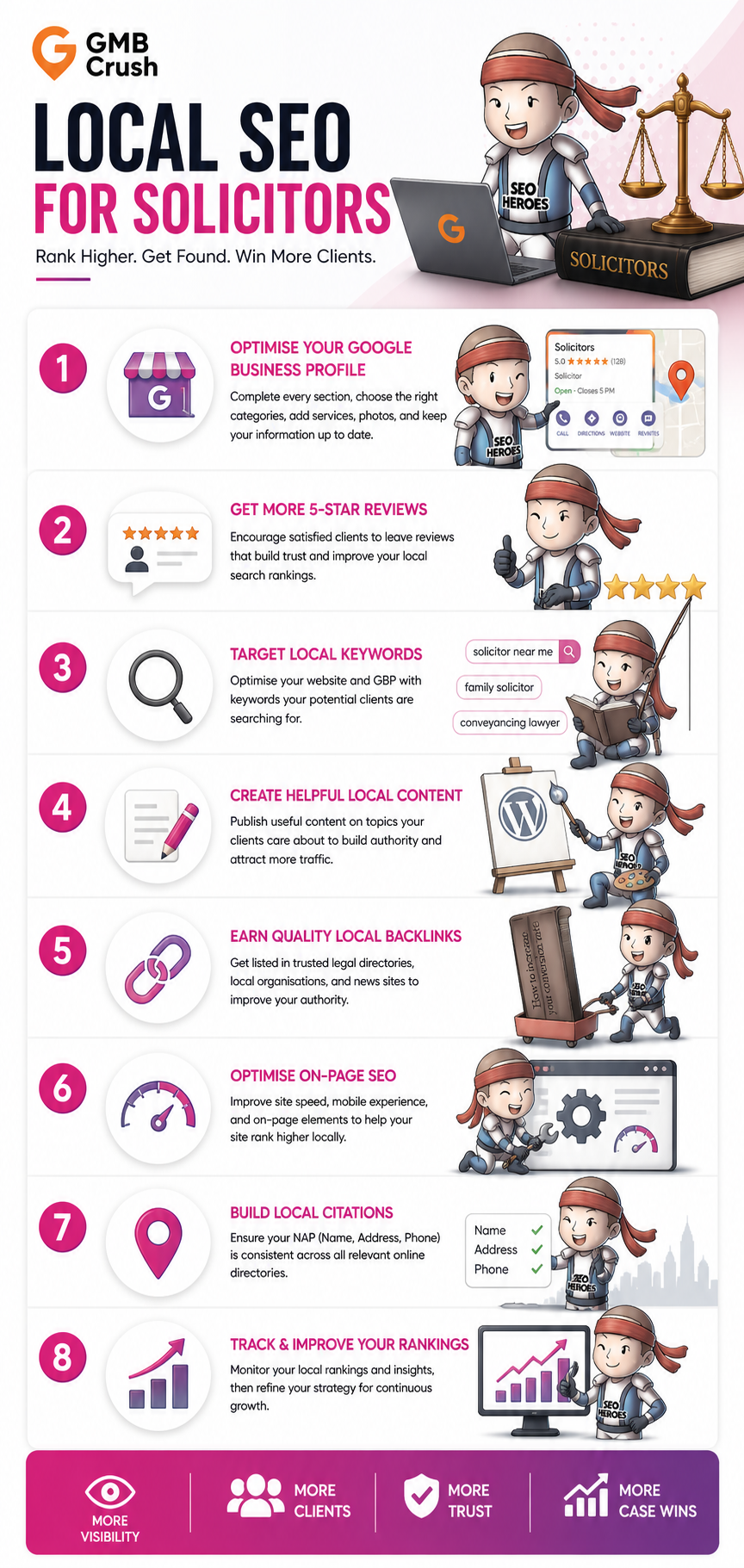
This guide covers the full local SEO playbook for solicitors specifically. For the broader legal picture across all firm types, see our guide on SEO for lawyers.
The way people find solicitors in the UK has shifted decisively toward Google Maps.
Whether someone needs a conveyancer for a house purchase, a family solicitor for a divorce, or a criminal defence lawyer after an arrest, the search almost always starts on Google.
The Local 3-Pack, which is the set of three business listings appearing above organic results for location-based searches, captures the dominant share of those clicks.
For solicitors, being outside the Map Pack is not a minor competitive disadvantage. It is near-total invisibility for the searches that drive new client enquiries.

The competition for Map Pack positions in UK legal searches varies significantly by location and practice area.
In major cities like London, Manchester, Birmingham, and Leeds, the Map Pack for ‘solicitors near me’ or ‘family solicitor [city]’ is fiercely contested.
In smaller towns and regional markets, the competition is often thinner, which means a properly optimised profile can dominate with less effort.
Either way, the mechanism is the same: the firms with the most complete, most relevant, and most trusted profiles win the positions. The rest do not appear.
The three ranking signals Google uses
Google evaluates local businesses on Relevance, Distance, and Prominence.
Your GBP category selection drives Relevance, determining whether Google considers your firm eligible to appear for a specific legal query.
Your office location drives Distance. Your reviews, profile completeness, and activity drive Prominence, the competitive layer that separates firms once the first two signals are satisfied.
Most solicitor firms are competitive on Distance because they are physically located in the markets they serve.
They lose on Relevance because their category configuration is too broad or incorrectly set, and on Prominence because their profiles are incomplete and their review cadence is inconsistent.
Website authority also feeds into Prominence Stellar SEO covers how link building works specifically for law firms if you want to go deeper on that side.
The question is whether you do the same before a competitor does.
Find Out Exactly Where You Rank on Google Maps
Run a geo-grid audit and see your Map Pack position across your full service area. Know where you are winning and where competitors are capturing clients that should be enquiring with you.
Category selection is where most UK solicitor firms make the decision that quietly limits their visibility for years.
The challenge in the UK legal market is that Google’s category taxonomy does not perfectly map to the Solicitors Regulation Authority’s practice area framework, and choosing the wrong category means competing for the wrong queries in the wrong pool of competitors.
The primary category question for UK solicitors
Google offers ‘Solicitor’ as a primary category, and this is the correct starting point for most general practice and multi-discipline firms.
However, ‘Solicitor’ is a broad category that places you in a wide competition pool for generic legal queries. For firms that concentrate their practice in specific areas, a more targeted primary category often produces better ranking results for the queries that drive their highest-value client enquiries.
Practice area primary categories to consider based on your firm’s main work:
- Conveyancing Solicitor: conveyancing is one of the highest-volume individual legal search categories in the UK. Residential property transactions drive enormous Google Maps search volume, and firms that set this as their primary category rank significantly better for conveyancing-specific queries than those using the generic ‘Solicitor’ category.
- Family Law Attorney: for firms where family matters including divorce, separation, and custody represent the majority of caseload. This maps to the highest-urgency search intent in the family law category.
- Personal Injury Attorney: for firms focused on accident claims, employer liability, and related matters. PI has its own distinct search intent and competition pool.
- Immigration Attorney: for firms specialising in visa applications, settlement, and related immigration matters, which have high and growing search volume in most UK cities.
- Employment Attorney: for firms handling employment disputes, tribunal representation, and related matters.
Secondary categories and practice area coverage
Secondary categories allow your firm to rank for distinct practice area searches without diluting the relevance of your primary category.
A firm with ‘Conveyancing Solicitor’ as primary and ‘Family Law Attorney,’ ‘Wills and Estate Planning Attorney,’ and ‘Solicitor’ as secondary categories creates eligibility for multiple query types simultaneously.
Add secondary categories only for practice areas you genuinely handle with dedicated capacity.
Google cross-references category signals against your review content and website.
A secondary category unsupported by evidence elsewhere on your profile creates a relevance mismatch.
You can see the exact primary and secondary category configuration driving the top-ranking firms in your local market by running a competitor audit inside GMB Crush, removing the need to guess what is working.
Your Competitors Are Already Using GMB Crush
Geo-grid ranking maps, GBP audits, competitor category analysis, AI Overview insights, and review monitoring. All in one platform. Start your 14-day trial today.
- Build a Profile That Converts
The gap between a solicitor profile that generates consistent enquiries and one that sits in the Map Pack without converting is almost always found in specific profile fields.
These are the decisions that determine whether a prospective client who finds your profile makes contact or moves to the next result.
Business description: write for the prospective client, not the SRA
Your business description is the most-read piece of content on your GBP profile.
It is read by people who have just found you in a search and are deciding whether to call or look at the next result.
A description written in formal legal language that reads like a firm brochure does not serve that decision.
A description written in plain English that directly addresses the situations your clients face and explains how your firm helps does.
State your practice areas clearly and in the language your clients use when they search.
‘We help clients with house purchases and sales, divorce and separation, employment disputes, and writing wills’ is more effective than ‘we provide comprehensive legal services across residential conveyancing, matrimonial law, employment law, and testamentary matters.’ State whether you offer free initial consultations.
State your geographic coverage. Make it easy for the person reading to confirm that you handle their situation before they pick up the phone.
Services menu: every practice area as a separate indexed signal
Google’s services section allows you to list individual practice areas with names and short descriptions, and each entry is indexed separately as a keyword signal.
This is one of the most underused optimisation opportunities on any solicitor profile.
For a general practice solicitor firm, a complete services menu might include: ‘Residential Conveyancing,’ ‘Lease Extensions and Enfranchisement,’ ‘Divorce and Legal Separation,’ ‘Child Arrangements Orders,’ ‘Will Writing and Estate Planning,’ ‘Probate and Estate Administration,’ ‘Employment Tribunal Representation,’ ‘Personal Injury Claims,’ ‘Commercial Property,’ ‘Business Contracts and Disputes.’
Each entry expands your keyword eligibility for the corresponding search queries without requiring any changes to your website.

Appointment link and consultation accessibility
Legal enquiries from Google Maps are time-sensitive. A prospective client who finds your profile and cannot immediately identify how to contact you or book a consultation will often move to the next result.
An appointment link connected directly to your enquiry form or consultation booking page adds a visible booking button to your profile and reduces the friction between discovery and first contact.
Phone number visibility matters more than many firms realise. Your phone number should be a number that is answered during business hours without exception.
A missed call from a Google Maps enquiry is a lost client in most legal categories, because the person will call the next firm on the list rather than leave a message and wait.
Accurate and complete business hours
Out-of-date or incorrect business hours are one of the most common reasons prospective clients form a negative first impression of a solicitor firm before any contact has been made.
A person who checks your profile on a bank holiday and sees standard hours listed, then arrives at your office or calls and finds no answer, will leave a negative review or simply never contact you again.
Use the Special Hours feature to mark bank holidays, office closures, and any deviations from your standard schedule.
Solicitor firms serve clients across geographic areas that often extend well beyond the immediate vicinity of their office.
A conveyancing firm in Manchester may handle transactions across Greater Manchester and into Cheshire.
A family solicitor in London may represent clients from multiple boroughs.
Understanding how to build geographic ranking signals across your actual service area is what separates firms that rank well locally from those that rank only for searches made within walking distance of their office.
Multi-office firms and GBP structure
For solicitor firms with multiple office locations, each physical office that serves clients at that address is eligible for its own GBP listing.
A firm with offices in Manchester city centre, Salford, and Stockport should have three separate, fully optimised GBP listings, each building its own local ranking signals, its own review profile, and its own practice area visibility in its respective local Map Pack.
The most common mistake multi-office firms make is creating the additional listings but managing them poorly.
Incomplete profiles, no practice area services listed, no independent review acquisition at each location, and all offices linking to the same generic website page rather than location-specific pages.
Each of these gaps leaves ranking potential uncaptured that a competitor with a single, well-managed office in that location will fill.
The ranking gap that standard analytics cannot show you
Your profile may rank well for searches conducted from your office address and rank poorly for the same search conducted from a neighbourhood two miles away.
From a standard Google search on your own device, you would never know this, because Google personalises results based on your location.
The gap exists invisibly, and it represents lost enquiries from prospective clients in areas you are perfectly capable of serving.
GMB Crush's geo-grid tracker maps your actual Map Pack ranking position across a grid of locations within your defined service area, showing precisely where you are visible and where competitor firms are capturing the enquiries that should be coming to you.
For firms operating in competitive urban markets, this data is the starting point for all targeted optimisation work rather than the guesswork that most solicitor firms rely on.
- Reviews Within SRA Guidelines
Review management for UK solicitors operates within a regulatory context that does not apply to most other local businesses.
The Solicitors Regulation Authority’s principles on client confidentiality and the prohibition on misleading communications affect both how you can ask for reviews and how you can respond to them publicly.
Understanding these constraints is what allows you to build a strong review profile compliantly, rather than avoiding review acquisition entirely because of uncertainty about the rules.
What the SRA principles mean for review requests
Asking clients for Google reviews is permitted and does not in itself breach SRA principles.
The constraints arise in how you ask and what you offer. Providing any form of incentive for a review, whether a discount, a gift, or any other benefit, is not permitted.
Asking clients to leave reviews only if their experience was positive, which is known as review gating, is not permitted under Google’s own guidelines and raises questions under SRA principles on honest communications.
What is both permitted and effective: a direct, personal request from the fee earner who handled the matter after case conclusion, framed as a genuine request for client feedback rather than a promotional ask.
This approach consistently produces better response rates than automated review request workflows in professional services, and it aligns with the relationship-based nature of how solicitor clients prefer to be communicated with.

Responding to reviews: professional standards in a public space
Every response you write to a Google review is publicly visible to every prospective client who views your profile.
The SRA’s principles on client confidentiality apply to public review responses in the same way they apply to any other public statement about a client matter.
You must not confirm or deny that the reviewer is a client, must not reference specific case details or outcomes, and must not disclose any information that could reasonably be considered confidential, even if the client has already disclosed it in their own review.
A compliant and effective response to a positive review: acknowledge the feedback warmly, reference the firm’s commitment to the values mentioned (communication, professionalism, responsiveness), and invite future contact.
A compliant response to a negative review: acknowledge the concern without confirming the client relationship, state that client experience is taken seriously, and invite direct contact to discuss further.
Why review volume drives ranking in UK legal searches
Review velocity, which is the consistent rate at which new reviews arrive over time, is a stronger ongoing ranking signal than total count in isolation.
A solicitor firm that consistently receives three to five new reviews per month signals an active, well-used practice to Google’s algorithm far more convincingly than a firm that ran a one-time review campaign and then stopped.
Build review acquisition into your standard case closure process, and the ranking benefit compounds over time without requiring any additional effort per review.
Stop Optimizing Blind
GMB Crush shows you exactly what your top-ranking competitors are doing, where you rank across your area, and what to fix first. No more guessing.
The way prospective clients find solicitors is changing as AI-driven search formats become more prevalent across Google’s results pages.
AI Overviews and the AI Pack format are reshaping how legal queries are answered and which firms are surfaced, and the solicitor firms that have built complete, structured profiles are gaining early visibility in the new format while those with thin profiles are losing ground they are not aware they are losing.

AI Overviews for legal queries in the UK
Google’s AI Overviews appear for legal informational queries with increasing frequency: ‘how does the conveyancing process work,’ ‘what does a family solicitor do,’ ‘how long does probate take in the UK,’ ‘do I need a solicitor for a house purchase.’
These AI-generated summaries appear prominently above the Map Pack and organic results, and they can surface local solicitor firms as recommended contacts alongside the information they provide.
The content that gets retrieved for these summaries comes from GBP profile data, review text, and website content. Firms whose profiles contain specific, plain-language descriptions of their practice areas and whose website content addresses common UK-specific legal questions are more likely to be included in AI-generated recommendations. This is current Google behaviour that is already affecting how prospective clients find solicitors in the UK.
The AI Pack and its impact on legal local search
Current Google behaviour shows the AI Pack format appearing for certain high-intent local service searches.
In this format, Google generates a brief AI-written summary of each firm based on structured GBP data and review content.
For legal queries with strong local and urgency signals, this format is appearing with increasing frequency in UK search results.
Firms with rich, complete profiles that include specific practice area service entries, consistent reviews mentioning practice area terms, and coherent website content are appearing in these AI-generated summaries.
Firms with generic, incomplete profiles are being passed over regardless of how long they have been operating or how strong their offline reputation is.
The AI retrieves structured data. Profiles that provide it get included. Profiles that do not get skipped.
What actually matters now: the solicitor firms investing in complete, structured GBP profiles are building a local visibility advantage that compounds as AI-driven search becomes the primary format for legal queries in the UK. The firms that treat this as a future concern rather than a current priority are ceding ground that becomes progressively harder to recover.
Multi-platform visibility beyond Google
Prospective clients in the UK are also using ChatGPT, Perplexity, and other AI platforms to ask for solicitor recommendations and legal guidance.
These systems retrieve structured business data from indexed sources, and a well-built GBP profile with precise categories, consistent reviews, and complete practice area descriptions is the content foundation that all of these systems draw from.
Optimising your GBP profile correctly creates citation eligibility across multiple AI platforms simultaneously, without requiring separate work for each one.
- GMB Crush Takeaways
The solicitors generating consistent enquiries from Google Maps are not necessarily the largest or most established firms in their markets. They are the firms that have treated their Google Business Profile as a managed, optimised asset rather than a directory listing they created and forgot. Here is what to act on this week:
- Review your primary category: if your firm has a dominant practice area that drives the majority of your enquiries, consider whether a specific category like ‘Conveyancing Solicitor,’ ‘Family Law Attorney,’ or ‘Immigration Attorney’ would place you in a more targeted competition pool than the generic ‘Solicitor’ category. Run a competitor audit in GMB Crush to see what the top-ranking firms in your area are using.
- Complete your services menu with every practice area your firm handles: each entry is indexed separately by Google and expands your keyword eligibility for the corresponding search queries. This is the fastest available keyword expansion for any solicitor profile.
- Build a compliant review request into your case closure process: a personal, direct ask from the fee earner after case conclusion consistently outperforms automated campaigns in professional services. Three to five new reviews per month is a sustainable target that compounds as a ranking signal over time.
- If your firm has multiple offices, confirm each has its own fully optimised GBP listing with a complete services menu, a location-specific website page, and its own review acquisition workflow. Each listing competes independently in its local Map Pack.
- Run a GMB Crush geo-grid audit for your top three practice area search terms across your service area: find exactly where competitor firms are capturing enquiries that should be coming to your firm, and direct your optimisation work toward those specific gaps rather than spreading effort evenly.
Every prospective client in your area who searches for a Law firm on Google is making a decision in the next few minutes.
Your profile is either visible, credible, and positioned to convert that search into an enquiry, or it is sending that person to a competitor who built a better one.
The gap between those two outcomes is not complicated to close.
The firms that close it first own their local market for years.
One Platform. Every Local Ranking Signal.
Audit, optimize, track, and outrank. GMB Crush gives you the data and the tools to dominate the Map Pack in your market. 14-day trial available.