
How to Use MarketMuse for GBP Copy and Location Pages
Writing GBP copy and local service content without knowing what keywords your competitors are ranking for is largely guesswork. AI content optimisation tools like MarketMuse change this by analysing the content that is currently ranking for your target queries and identifying the specific topics, terms, and depth of coverage your own content needs to compete.
For local SEO practitioners and business owners writing their own GBP descriptions, service entries, and location pages, these tools provide a data foundation that replaces assumptions with evidence.
This guide covers what MarketMuse does, how its core features work, and specifically how to apply its outputs to the local SEO content tasks that matter most: your GBP business description, services menu entries, and the location pages on your website that reinforce your GBP entity signals.
AI content optimisation tools operate on a straightforward principle: they analyse the pages currently ranking in the top positions for a target keyword and identify what those pages cover, how thoroughly they cover it, and which related terms and concepts they include.
The output is a set of recommendations for your own content that tell you which topics to include, which terms to use, and how comprehensive your content needs to be to compete with the current top-ranking pages.
For traditional SEO copywriting, blog posts, service pages, and long-form content, these tools are widely used because the competitive landscape is clear and the output is directly actionable.
For local SEO copywriting, the application is less obvious but equally valuable when done correctly.
Your GBP business description, services menu entries, and location pages all need to reflect the keyword landscape for your category and location, and an AI content tool can tell you exactly what that landscape looks like.

The limitation to understand upfront
AI content tools analyse organic search results, not specifically GBP profiles or Map Pack rankings.
The keywords and topics they surface are drawn from the website content that ranks for your queries, not from GBP profile data directly.
This means their output is most directly applicable to your website content (location pages, service pages) and is used more indirectly for GBP profile copy.
Understanding this distinction prevents over-engineering your GBP description using organic SEO keyword density rules that do not directly apply to GBP ranking.
See What Your Competitors Are Writing on Their Profiles
Before optimising your GBP copy, run a GMB Crush competitor audit to see the full profile configuration of the businesses outranking you, including their services menu and description choices.
MarketMuse is one of the most established AI content optimisation platforms in the SEO industry. It was one of the first tools to apply machine learning to content competitive analysis at scale, and its core features remain well-suited for the local SEO content tasks described in this guide.
MarketMuse offers a limited-query tier that allows you to run a meaningful number of analyses per month without a paid subscription, alongside paid tiers for higher volume usage.
Optimize
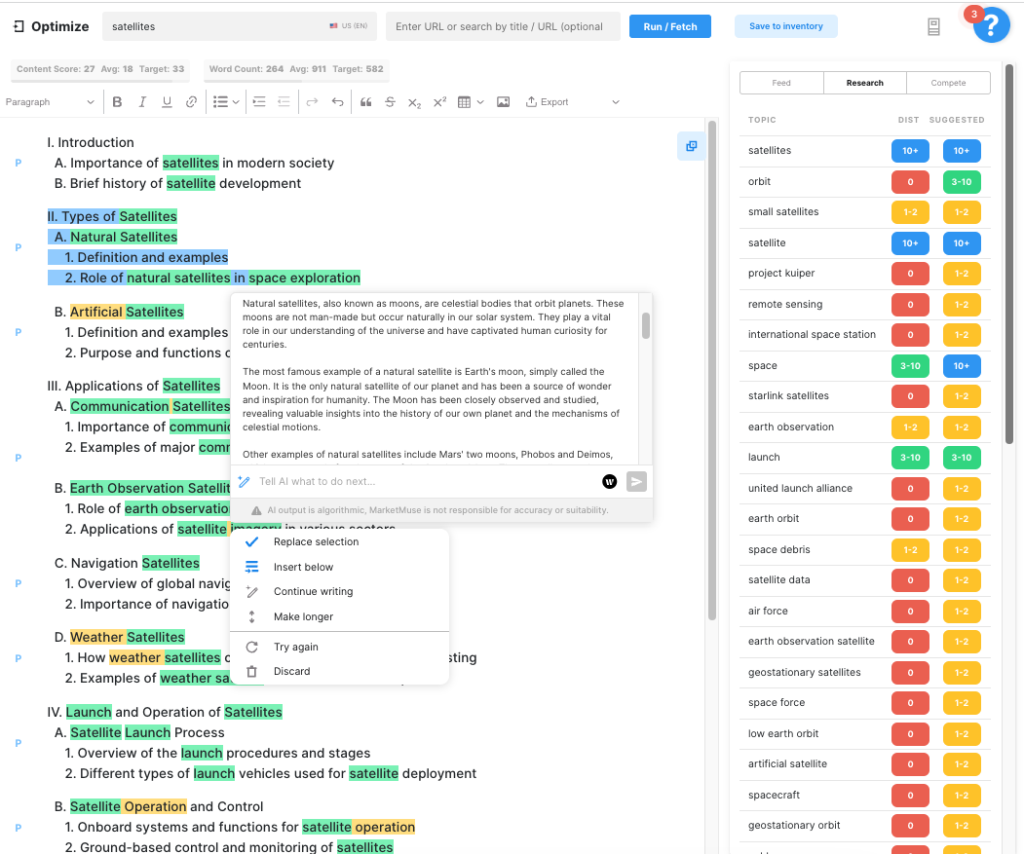
The Optimize tool is the core content scoring feature in MarketMuse. You provide a target keyword and a URL (your existing content or a blank editor), and MarketMuse analyses the top-ranking pages for that keyword and scores your content against the competitive standard.
The right panel shows a list of topic terms and their target usage frequencies based on what the top-ranking pages include, alongside your content’s current score and the target score needed to match top-ranking content depth.
For a local service page or location page, entering your target keyword (for example, ’emergency plumber Manchester’ or ‘Invisalign dentist Edinburgh’) and your page URL gives you a direct comparison of your content’s topical coverage against the pages currently ranking at the top for that query.
The terms listed as gaps are the topics your page needs to address more thoroughly to match the competitive standard.
Research
The Research tool queries the current search landscape for a keyword and surfaces a structured topic model: the related topics, subtopics, and questions that authoritative pages on this subject cover.
For local content writers, the Research output helps identify the aspects of a local service that customers are searching for beyond the primary keyword, the questions they ask, the concerns they have, and the related services they compare.
This informs both the location page content structure and the service descriptions on your GBP profile.
Compete
The Compete feature allows you to compare your content directly against specific competing pages for a target keyword.
It provides three views: a heatmap showing keyword usage frequency across competing pages, a list view comparing content scores and word counts, and a head-to-head view comparing your page against a single competitor.
For local SEO, the most useful application is comparing your location page against the top one or two competing pages for your primary local service keyword, identifying the specific topical gaps between your coverage and the pages outranking you.
Questions
The Questions feature surfaces the specific questions being asked about a topic across search queries.
For local service content, these questions map directly to the sections your location pages and GBP descriptions should address.
A plumber whose Questions analysis surfaces ‘what is the average cost of a boiler replacement?’, ‘how long does a boiler installation take?’, and ‘do I need to be home for a plumber?’ has a content brief for both their website service page and potentially their GBP description and posts.
Product posts
Product posts are available for certain business categories and allow you to feature specific products with photos, descriptions, and pricing directly on your profile.
They appear in a product carousel on your listing and allow customers to browse what you offer without leaving Google.
For retail businesses, cafes, and other product-focused categories, maintaining a current product catalogue through product posts adds a browsable layer to your profile that drives engagement and signals relevance for product-specific searches.
- Applying MarketMuse to GBP Copy
GBP copy operates under character limits and specific structural rules that organic SEO content does not.
Applying MarketMuse’s outputs to GBP copy requires translating the longer-form content recommendations into the constrained fields of the GBP profile.
Using Optimize output for your GBP business description
Run the Optimize tool for your primary local service keyword, the search term you most want to rank for in the Map Pack. Review the topic terms identified as important for that query.
Your GBP business description should naturally include the most relevant two or three of these terms without keyword stuffing. The terms that appear most consistently across top-ranking pages for your query are the ones your description should include when they can be incorporated naturally.
The character limit (750) means you cannot include every recommended term. Use the topic analysis to identify which terms are most central to your primary query and prioritise those.
The less central terms can be addressed through service menu entries and GBP posts rather than the main description.
Using Research output for services menu entries
The Research tool’s topic model often surfaces service subtypes and related service queries that are worth adding as individual services menu entries.
If the Research output for your primary service keyword surfaces related terms like ’emergency service,’ ‘same-day response,’ or specific service variants that your business offers, each of these is a candidate for a separate services menu entry. Services menu entries are indexed individually, so each entry expands your query eligibility independently.
Using Questions output for GBP posts
The questions surfaced by the Questions feature are exactly the kind of content that performs well as GBP posts.
A post that directly answers ‘how much does X cost’ or ‘how quickly can you respond’ addresses the intent behind questions your prospective customers are already asking.
These posts also perform well in AI Overview retrieval because they provide specific, answerable information in a format the AI can retrieve and cite.
Location pages are where MarketMuse’s full capability is most applicable.
Unlike GBP profile fields, location pages have no character limits and can incorporate the full depth of topical coverage that MarketMuse’s analysis recommends.
The analysis workflow for a location page
For each location page you want to optimise, run the following MarketMuse workflow.
First, use Optimize with your target local keyword to score your existing page and identify topical gaps.
Second, use Research to build a complete topic model for the local service, including the related subtopics and questions.
Third, use Compete to compare your page against the top two pages ranking for that query and identify the specific coverage differences.
The output of this three-step workflow is a content brief for your location page that specifies which topics to add, which questions to answer, and approximately how comprehensive the coverage needs to be to match the pages currently outranking yours.
Write to the brief rather than to a generic template and your location page becomes a competitive content asset rather than a thin directory-style entry.
Local qualifier in keyword targeting
When running analyses for local content, always include the geographic qualifier in your target keyword. ‘Emergency plumber’ and ’emergency plumber Manchester’ return different topic models and different competitor pages.
You want the analysis for the geographically specific query because that is what you are competing to rank for, and the content that ranks for the local query may be structured differently from the content that ranks for the generic query.
The key factor is this: MarketMuse and tools like it tell you what content the top-ranking pages for your query contain. That is useful for your website content. For your GBP profile copy, the equivalent competitive intelligence comes from your GMB Crush competitor audit which shows you the specific profile configuration of the businesses currently holding the Map Pack positions you want. Use both tools for their respective strengths.
- Getting Started with MarketMuse
MarketMuse is available at marketmuse.com. The platform offers a limited-query tier that allows a meaningful number of analyses per month without a subscription sufficient for a small number of priority content projects.
Paid tiers offer higher query volumes and additional features for higher-volume content operations.
Getting the most from a limited query allowance
If you are working within a limited query allowance, prioritise your most important local service keywords for the Optimize and Compete analyses.
Run Research for your primary service category to build a durable topic model that can inform multiple content pieces without using a query for each.
Save your query credits for the pages that will have the highest impact on your local rankings if optimised typically your main location page and your highest-priority service pages.
Complementary tools in the same category
Several tools operate in the same AI content optimisation category as MarketMuse and are worth comparing for your specific workflow: Clearscope, Frase, and Surfer SEO offer overlapping functionality with different interface approaches and pricing structures.
All work on the same principle of analysing top-ranking content to generate recommendations for your own pages.
The choice between them comes down to interface preference and integration needs with your existing content workflow rather than fundamentally different capabilities.
Recommended Reading
SEO Copywriting for Local Businesses: how to write GBP copy that ranks and converts
Track How Your Improved Content Affects Your Rankings
GMB Crush’s geo-grid maps your Map Pack position across your full service area so you can see the ranking impact of content and copy improvements over time.
AI content tools fit into a specific part of the local SEO workflow, not all of it.
Understanding where they add value and where other tools are more appropriate prevents over-reliance on content analysis for problems that have different root causes.
When to use AI content tools
Use AI content tools when you are writing or revising website content location pages, service pages, blog content targeting local service queries.
They are most valuable when you have a specific page you want to rank for a specific local query and you need to understand what the top-ranking pages cover that yours currently does not.
They are also useful for building content briefs when creating new location pages for a multi-location business.
When to use GBP profile tools instead
For Map Pack ranking specifically, GBP profile optimisation produces more direct ranking impact than website content optimisation in most cases. If your ranking is the primary goal, start with your GBP profile category precision, services menu completeness, review velocity, profile activity before moving to website content depth.
AI content tools help you compete more effectively once the foundational GBP signals are correctly configured, not as a substitute for getting those signals right first.
The complete local content workflow
The most effective local content workflow combines both approaches: GMB Crush competitor audit data to understand the profile-level competitive landscape and identify GBP copy gaps, and AI content tool analysis to understand the website content competitive landscape and identify location page gaps.
The two data sources are complementary one tells you what is working in Google’s local ranking algorithm at the profile level, the other tells you what is working in organic search at the website content level. Together they give you a complete picture of what you need to improve to compete more effectively across both channels.
- GMB Crush Takeaways
AI content tools like MarketMuse bring systematic competitive analysis to the content writing process that was previously only available through manual research.
For local SEO practitioners, they are most valuable for website content and least valuable for GBP profile copy, which is governed by different rules and a different ranking mechanism.
Here is the practical framework:
- Use MarketMuse Optimize and Compete for your location pages: run the analysis with a geographically specific local keyword to get a competitive content comparison against the pages currently ranking for your target query. Address the topical gaps the analysis identifies.
- Use MarketMuse Research to build topic models for your primary service categories: the related topics and questions surfaced inform multiple content pieces across your website and your GBP posts without using a query for each individual piece.
- Apply Questions output to your GBP post strategy: the questions customers are asking about your service type are excellent GBP post topics. Posts that answer specific questions perform well in both traditional Map Pack visibility and AI Overview retrieval.
- Use GMB Crush competitor audit for GBP profile copy: the profile-level competitive intelligence for your GBP description and services menu comes from seeing what the top-ranking profiles in your local Map Pack are doing, not from organic search analysis. Run a competitor audit first, then use that data to write your profile copy.
- Start with GBP profile optimisation before website content: for most local businesses, fixing GBP category precision, completing the services menu, and building review velocity will move Map Pack rankings faster than website content improvements. Use AI content tools once the profile fundamentals are correct.
The best content is content that answers the specific questions your prospective customers are asking, covers the topics Google’s top-ranking pages include, and does both in customer language rather than industry terminology.
AI content tools help you identify what those questions and topics are. The discipline of actually writing copy that meets that standard is still yours.
One Platform. Every Local Ranking Signal.
Audit, optimise, track, and outrank. GMB Crush gives businesses and agencies the competitor data to write GBP copy that ranks and the geo-grid to measure whether it is working. 14-day trial, no credit card required.